April 2026 — Manage it Pros
Most projects don’t fall apart because of one big mistake.
They become harder than they need to be.
Decisions take longer.
Feedback loops multiply.
Work keeps moving, but not always in the same direction.
And by the time teams realize something’s off, they’re already deep into execution.
Over the years, we kept seeing the same patterns show up across different teams, industries and projects.
So we started pulling them together into a framework.
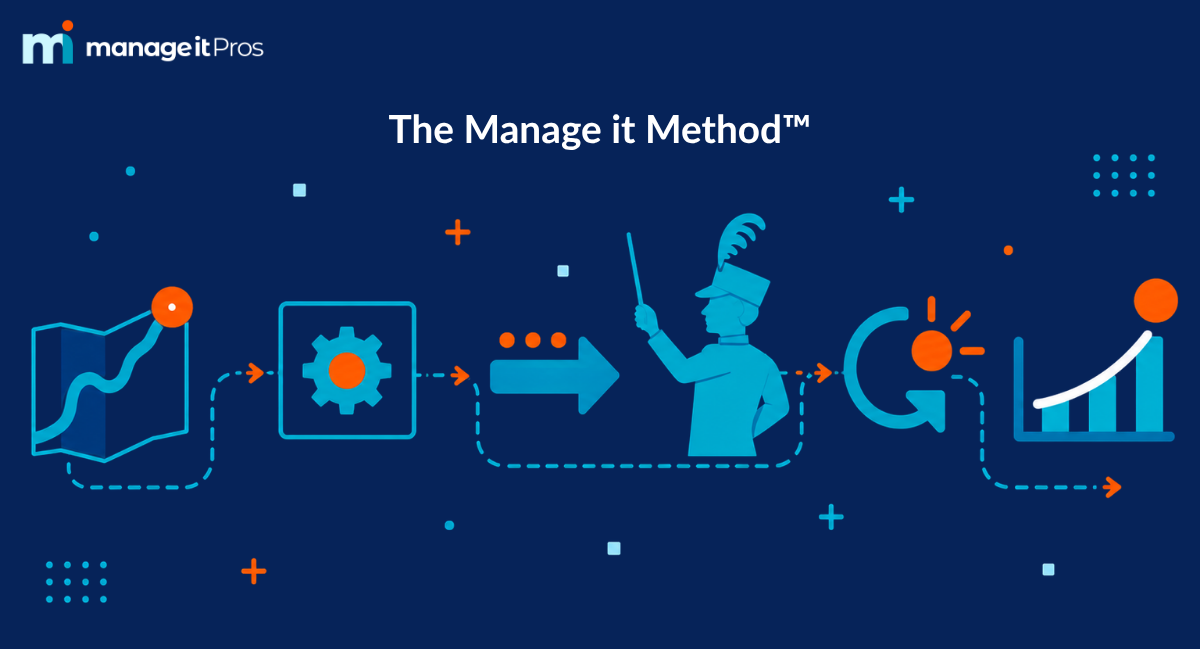
The Manage it Method™
The method is a five-phase approach to structuring work so it holds up once things get moving.-png-2.png?width=479&height=250&name=Untitled%20design%20(1)-png-2.png)
At a high level, the Method breaks down into five phases:
MAP → MAKE → MANAGE → MODIFY → METABOLIZE
Each one solves a different part of how work runs. Together, these phases create a practical framework for navigating the realities of creative and cross-functional work.
Not in theory.
In practice.
1. MAP: Clarity Before Movement
Most projects start with momentum.
Fewer start with real clarity.
MAP is about slowing down just enough to align on what actually matters:
what problem you’re solving?
what success looks like?
what constraints you’re working within?
When this step is rushed, teams often revisit the same questions later, usually when timelines are tighter and decisions are harder to make.
When it’s done well, everything that follows becomes easier to navigate.
2. MAKE: Turning Clarity Into Structure
Clarity on its own isn’t enough.
Once alignment exists, it needs to translate into something the team can actually execute against.
MAKE is where alignment becomes structure:
how work flows
how decisions happen
how ownership is defined
Many teams rely on default tools and processes that weren’t designed for the work they’re doing.
When structure fits the work, things move with less friction.
When it doesn’t, teams spend more time managing the process than doing the work.
3. MANAGE: Leading the Work in Motion
Execution is where even well-structured projects can start to drift.
MANAGE is less about tracking tasks and more about maintaining momentum:
keeping communication clear
guiding decisions as they arise
protecting the team’s focus
We often describe this as setting the rhythm of the work.
Not controlling every move,
but making sure the team stays aligned as things evolve.
4. MODIFY: The Moment Most Teams Skip
Projects rarely follow a straight line.
But most teams treat them like they should.
MODIFY introduces a deliberate pause:
a moment to reassess direction, surface friction, and adjust before small issues compound.
This can feel counterintuitive.
Pausing can look like slowing down.
In practice, it usually does the opposite.
It prevents rework, reduces misalignment, and keeps the work moving in the right direction.
5. METABOLIZE: Turning Work Into Learning
Most teams finish a project and move straight into the next one.
METABOLIZE is about not losing what you’ve learned along the way.
It creates space to reflect on both operational outcomes and team experiences.
What worked?
What didn't?
What should be repeated?
What should change?
What created friction?
Without this step, teams tend to repeat the same patterns.
With it, each project strengthens the next.
Why This Works
The Manage it Method™ isn’t about adding more process.
It’s about structuring work in a way that reflects how it actually happens.
It combines:
- clarity and systems
- accountability and ownership
- structured decision-making
- human dynamics and team alignment
- continuous learning and improvement
Because projects don’t run on plans alone.
They run on how people interpret, communicate, collaborate and move through the work together.
A Different Way to Think About Project Work
Most frameworks focus on what should happen.
This one is built around what actually does and it provides a practical structure for navigating that reality.
That’s the difference.
Where to Start
If there’s one place to begin, it’s with MAP.
Clarity at the start changes everything that follows.
Because when teams know what they're building, why it matters, and how they'll work together, the rest of the process becomes far easier to navigate.
That's where the Manage it Method™ begins.
Want to put MAP into practice? Download the Impact-Led Project Brief template and start creating clarity before the work begins.

.png?width=1209&height=476&name=Newsletter%20CTA%20(1).png)
.png)